PinHole® Clinic | Patient education article
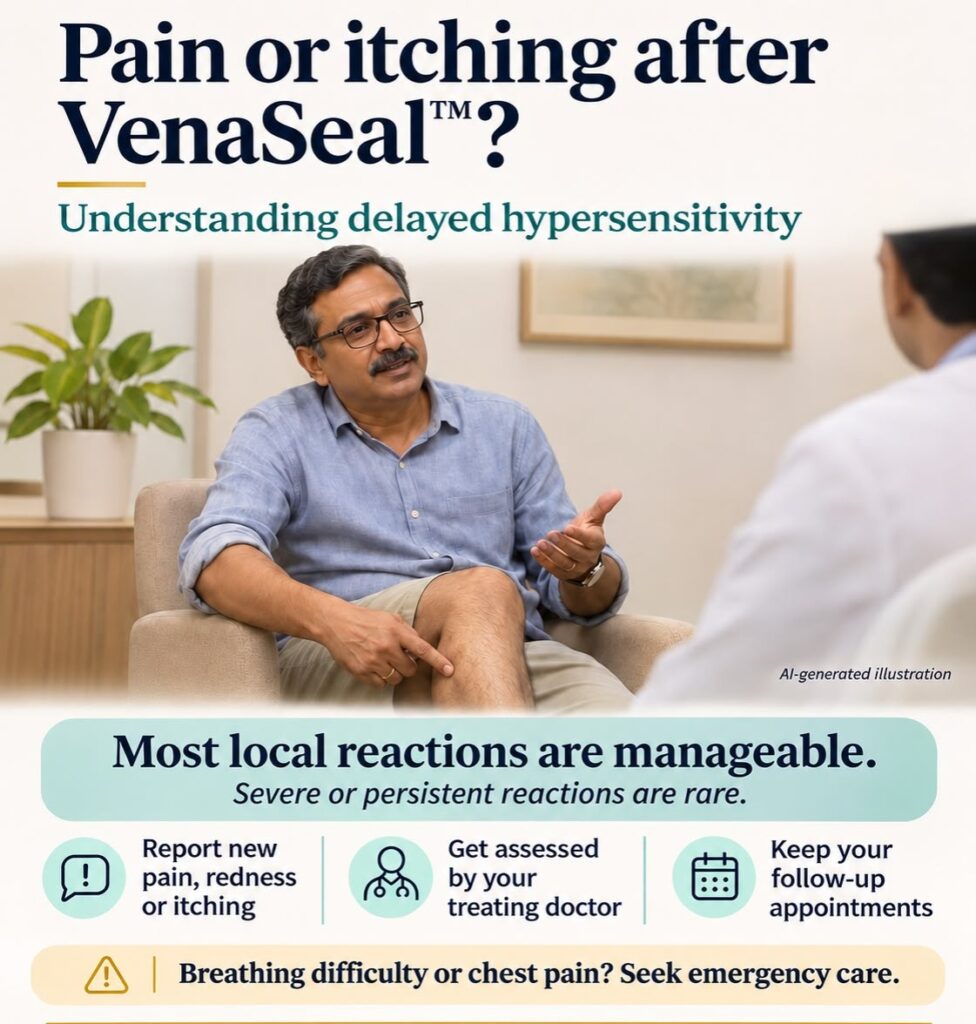
New pain or itching after vein treatment deserves review. Most local reactions are manageable, and early contact with the treating doctor helps patients receive appropriate assessment and care.
A patient story
A 47-year-old gentleman had consulted several doctors for varicose veins and had decided to undergo laser treatment. On someone’s recommendation, he visited me to understand whether VenaSeal™ could be another option.
We discussed how the procedure works, its benefits, limitations and possible reactions. After considering the options, he chose VenaSeal treatment. He initially responded well, with mild discomfort along the treated area during the first week.
Around one month later, he returned with pain along the treated vein. On ultrasound, we noticed thickening of the vein. Taken together with the clinical assessment, this suggested a delayed hypersensitivity reaction.
What delayed hypersensitivity means
VenaSeal uses a medical adhesive called cyanoacrylate to close an affected vein. In some patients, the immune system reacts to this material, producing redness, itching, tenderness or swelling along the treated vein. Symptoms may develop days or weeks after treatment. Pain or ultrasound thickening alone does not confirm an allergy; other causes must also be considered.
How common these reactions are
These symptoms do not affect everyone. Many patients do not develop hypersensitivity. Most reported reactions are mild or moderate, while severe or persistent reactions are rare. Published rates vary, so hypersensitivity should be understood as a recognised possible reaction rather than dismissed as extremely unlikely.
How reactions are managed
Most local reactions can be managed following assessment by the treating doctor. Depending on the symptoms, treatment may include anti-inflammatory medication, medicine for itching, or a prescribed steroid course in selected cases. A short course may be sufficient, but some patients need longer treatment and follow-up.
The reassuring message is that treatment is available. Report symptoms early rather than leaving them unattended. Recovery within one week cannot be guaranteed.
Why technique and allergy history matter
VenaSeal requires careful ultrasound-guided technique, controlled adhesive delivery and attention to the catheter entry site. Avoiding adhesive deposition outside the vein is important because exposure of surrounding tissues can contribute to local complications. However, hypersensitivity can occur even when the adhesive remains inside the vein. A reaction does not automatically indicate glue leakage or an incorrectly performed procedure.
Before treatment, tell your doctor about previous reactions to medical adhesives or glues. Known hypersensitivity to VenaSeal adhesive or cyanoacrylates is a contraindication.
Exercise and massage after treatment
Exercise or massage should not be assumed to cause an allergic reaction. Follow the activity instructions provided by your treating doctor, and avoid vigorously massaging a painful area until it has been assessed.
Travelling out of town or abroad
At PinHole® Clinic, we have treated patients who subsequently travelled out of town or returned abroad, with ongoing follow-up through online consultations.
Travel plans should be discussed individually, considering recovery, journey duration and the patient’s clotting risk. Online follow-up helps maintain contact, but new symptoms may require an examination or Doppler scan near the patient’s location.
When to seek medical help
Contact your treating doctor promptly for new or worsening pain, redness, itching or swelling. Fever, discharge or a wound also needs review.
Breathing difficulty, facial or tongue swelling, chest pain, fainting, or sudden marked swelling of the leg requires urgent medical attention. These symptoms should not be assumed to be a simple local reaction. Serious allergic and clot-related complications are among the recognised potential risks of treatment.
My message to patients is simple: there is no need to assume the worst, but do not ignore new symptoms. Understanding possible reactions and staying in touch with your doctor are important parts of recovery.
Dr Rohit Madhurkar | Lead Consultant | Senior Interventional Radiologist | Apollo Hospitals Bangalore | PinHole Clinic
Google Business Profile update
Pain or itching after VenaSeal treatment
A 47-year-old patient initially recovered well after VenaSeal treatment for varicose veins. Around one month later, he returned with pain along the treated vein. Clinical assessment suggested a delayed hypersensitivity reaction.
These symptoms do not affect everyone. Most reported local reactions are mild or moderate; severe or persistent reactions are rare. Treatment depends on the assessment, and recovery time varies.
At PinHole® Clinic, we have also treated patients who later travelled out of town or returned abroad, continuing follow-up online. Travel clearance is individual, and new symptoms may require a local examination or Doppler scan.
- Report new pain, redness, itching or swelling early.
- Avoid vigorously massaging a painful area.
- Take medicines as prescribed and keep follow-up appointments.
Breathing difficulty, facial swelling or chest pain requires emergency care.
Dr Rohit Madhurkar | Senior Interventional Radiologist
PinHole® Clinic, Bengaluru
Medical references
- Lee et al. Retrospective study of hypersensitivity reactions in patients undergoing cyanoacrylate closure of lower extremity superficial veins. 2025. https://pmc.ncbi.nlm.nih.gov/articles/PMC12099872/
- Jones et al. Persistent type IV hypersensitivity after cyanoacrylate closure of the great saphenous vein. 2019. https://pmc.ncbi.nlm.nih.gov/articles/PMC6699189/
- Medtronic. Varicose Vein Therapies — Important Safety Information. https://europe.medtronic.com/in-en/patients/treatments-therapies/varicose-vein-therapies/important-safety-information.html
This story is shared for educational purposes. Treatment decisions and outcomes vary from person to person. Please consult a qualified medical specialist for advice regarding your condition.