
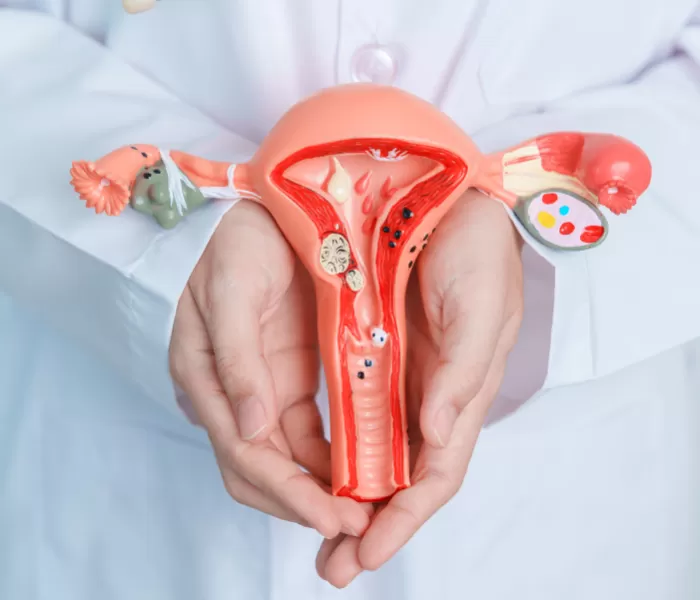
Fibroid Treatment Without Surgery in Bangalore – Causes, Symptoms & UFE Treatment
With Advanced Minimally Invasive Pinhole Precision Techniques
Fibroid Treatment Without Surgery in Bangalore with Dr. Rohit Madhurkar & Team
Understanding Uterine Fibroids: A New Era of Care
Uterine fibroids are very common and harmless growths that occur within or around the uterus during a woman’s reproductive years. Some fibroids can remain small and not affect the woman at all. At the same time, some may cause symptoms such as excessive bleeding, pelvic pain, frequent urination, pain during sex, and infertility, in addition to reduced quality of life for the woman affected by fibroids. Before modern advances, the only means to cure fibroids was through surgery.
Currently, modern, highly effective alternatives to surgery for fibroids are available at a Bangalore clinic, using advanced technologies for precise, minimally invasive pinhole procedures. The most reliable method for this is uterine fibroid embolisation and ablation, performed by expert interventional radiologists specialising in fibroids and adenomyosis.
Common Symptoms of Uterine Fibroids
In women who have uterine fibroids, the following could represent symptoms:
- Excessive or prolonged uterine bleeding
- Pelvic pain or pressure
- Frequent urination due to bladder compression
- Painful sex
- Constipation or discomfort
- Lower back pain
- Enlarged or distended abdomen
- Difficulty in conception or miscarriages
Causes and Risk Factors of Uterine Fibroids
Although the exact cause of fibroids remains unclear, several factors have been identified that contribute to their development. One factor is hormonal imbalance, involving oestrogen and progesterone. Women who have a family history of fibroids tend to be more prone to developing them.
Other significant risk factors include obesity, lifestyle and dietary habits, early menarche, vitamin D deficiency, and environmental and genetic factors. Awareness of these risk factors helps with early diagnosis and intervention.
Types of Uterine Fibroids (Intramural, Subserosal, Submucosal & Pedunculated)
Fibroids are grouped depending on their position within the uterus. Intramural fibroids grow within the walls of the uterus and are the most common type. Subserosal fibroids develop on the outer wall of the uterus. Submucosal fibroids form on the inner lining of the uterus and are responsible for causing bleeding, pressure symptoms, and infertility.
Pedunculated Fibroids – Pedunculated fibroids grow from the uterus through a stalk and might cause twisting of the fibroid, resulting in pain.
Difference between pedunculated and subserosal fibroids – As a simple example, a pedunculated fibroid is like a mango hanging from a tree, whereas a subserosal fibroid is like a beehive — broad-based and completely attached to the uterus.
Adenomyosis – This is not actually considered a type of fibroid, though it may be related, as the growth arises from the endometrium lining into the muscle wall of the uterus, causing excessive bleeding and painful contractions.
Types of Adenomyosis – Focal, diffuse & adenomyoma.
Diagnosis and Fibroid Mapping Using Ultrasound & MRI
Fibroids can be diagnosed through both conventional and advanced imaging techniques. The traditional method includes a pelvic and transvaginal ultrasound scan. The advanced method includes dedicated MRI fibroid scanning with angio and venous phase imaging, which helps determine the location, size, number, vascularity, and blood supply, and also rules out other possible conditions.
A physical pelvic examination helps detect uterine enlargement, and fibroid mapping further aids in managing the condition. Further blood workup is recommended to investigate anaemia, if any, due to excessive uterine bleeding or other causes.
Treatment Options for Fibroids Without Surgery
Treatment depends on the patient, based on symptoms, the type of fibroids, the woman’s age, and her plans for having children. In mild cases, treatment can be managed with medication. In others, advanced methods are suggested based on symptoms.
One of the most widely accepted alternatives to surgery is Uterine Fibroid Embolisation (UFE). There are also other interventional radiology procedures classified as fibroid and adenomyosis ablation methods. Another known alternative is MRI-guided focused ultrasound (MRgFUS), which is non-invasive but not offered at PinHole.
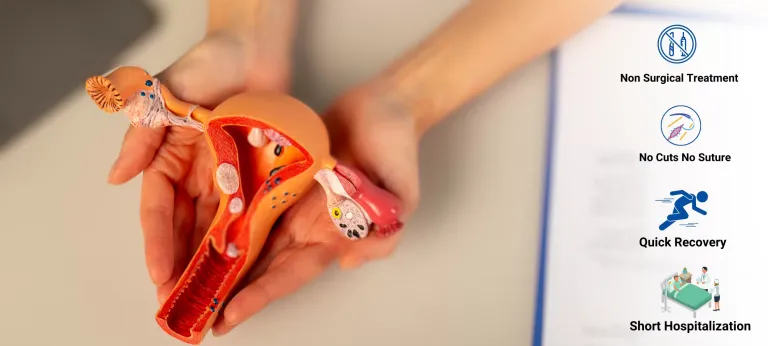
Why Choose Fibroid Treatment Without Surgery Over Open Surgery?
There are many advantages to non-surgical techniques for treating fibroids compared to the traditional open-surgery approach. In non-surgical techniques, the procedure is performed by entering the fibroid’s blood supply via the wrist or groin and stopping blood flow to the fibroid, so there are no cuts or stitches to the body, and the uterus is not removed. It reduces symptoms of heavy bleeding and pain, as well as the risk of infection.
The healing process is fast, with women able to return home within 24 hours and resume their usual activities within a matter of days. Blood loss with non-surgical techniques is negligible compared to surgery. The technology used allows the treatment to travel to the fibroid via the blood vessels of the body.
Psychologically, retaining the uterus and its functions has a significant positive impact on a woman’s mental well-being. Many women report a noticeable reduction in sexual libido after surgery, whereas after Uterine Fibroid Embolisation (UFE), sexual libido is generally preserved and may even improve, with patients often feeling healthier and younger.
As it is uterus-sparing, UFE is highly valued by women of childbearing age who may want to conceive in the future or wish to avoid having an organ removed permanently.
Quality of Life – Furthermore, these options provide a higher quality of life than surgical options, which entail strict post-operative restrictions.
Myomectomy Versus Hysterectomy
Myomectomy
Myomectomy is a surgical operation that entails removal of fibroids while conserving the uterus. It is ideal for women who wish to conceive in the future and is well suited to patients with fewer fibroids. The sole drawback of this surgical method is that fibroids sometimes regrow, or all fibroids cannot be removed. Recovery depends on whether the procedure is laparoscopic, robotic, or open surgery. UFE would be a better option for most patients.
Hysterectomy
Hysterectomy involves removal of the uterus along with the fibroids, resulting in permanent removal of the uterus. It takes comparatively longer to heal, and in most cases is performed only in very difficult situations. Due to the latest advancements in medical science related to preserving the uterus with UFE and ablation, hysterectomy now remains a last resort.
UFE vs Myomectomy: Choosing the Best Fibroid Treatment
Uterine Fibroid Embolisation (UFE) is a minimally invasive pinhole procedure performed by interventional radiologists under image guidance. Through a tiny puncture — usually at the wrist or groin — microscopic embolic particles are delivered into the arteries supplying the fibroids. By selectively blocking the blood supply, the fibroids gradually shrink, soften, and become inactive, leading to significant improvement in symptoms.
UFE is primarily suitable for most women, particularly those with multiple fibroids, women searching for fibroid treatment without surgery in Bangalore, or women who wish to preserve the uterus and avoid major surgery. As a uterus-preserving, pinhole procedure, UFE offers several advantages, including no surgical cuts or stitches, minimal blood loss, shorter hospital stay, faster recovery, and excellent long-term symptom control when performed by an experienced interventional radiologist such as Dr. Rohit Madhurkar.
Myomectomy is a surgical procedure aimed at physically removing fibroids from the uterus. It is commonly performed laparoscopically and increasingly with robotic assistance. During myomectomy, an incision is made into the uterine wall, the fibroid is excised, and the uterus is sutured back. Smaller fibroids can be removed through laparoscopic ports, while larger fibroids often need to be fragmented within the abdominal cavity before removal, with meticulous care taken to prevent fragment spillage. This procedure involves direct cutting, suturing, and manipulation of the uterus, which may impact recovery time and uterine integrity.
Surgical Options (If Needed) – Sometimes, surgery is also recommended. These include robotic myomectomy, laparoscopy and hysteroscopy, or open myomectomy.
Importantly, while myomectomy removes visible fibroids, it does not treat the underlying tendency to form new fibroids, making recurrence possible. UFE, by targeting the fibroid blood supply throughout the uterus, treats both visible and microscopic fibroids, often resulting in lower recurrence rates.
UFE vs Myomectomy: Key Differences
| Feature | UFE (Uterine Fibroid Embolisation) | Myomectomy |
|---|---|---|
| Procedure type | Minimally invasive, pinhole | Surgical |
| Performed by | Interventional Radiologist | Gynecologic Surgeon |
| Skin incision | Tiny puncture (wrist/groin) | Multiple abdominal or uterine incisions |
| Uterine cutting | No cutting of uterus | Uterus is cut and sutured |
| Anaesthesia | Local ± mild sedation | General anaesthesia |
| Blood loss | Minimal | Moderate to high |
| Treatment of multiple fibroids | Treats all fibroids simultaneously | Removes selected fibroids only |
| Risk of new fibroids | Lower | Higher |
| Hospital stay | Same day or 1 night | 2–4 days |
| Recovery time | 3–7 days | 3–6 weeks |
| Scarring | None | Abdominal and uterine scars |
| Impact on uterus | Preserved, not manipulated | Manipulated and sutured |
| Sexual well-being | Usually preserved or improved | May be affected in some cases |
| Return to work | Within a few days | Several weeks |
| By fibroid number and size | Most can be treated — including pedunculated (usually subserosal) and very large fibroids | Good for subserosal, pedunculated, and smaller fibroids |
Final Thought
The choice between UFE and myomectomy depends on fibroid type, symptoms, fertility plans, and personal preference. A detailed consultation with both a gynaecologist and an experienced interventional radiologist ensures women receive the right treatment for the right indication, with the best balance of safety, effectiveness, and quality of life.
Recovery & Post-Treatment Care – UFE
Recovery from this procedure usually occurs without complications. Gentle walking should be encouraged, while pain can be managed with medication. Most women return to their daily activities within a day or two. Follow-up scans help monitor any concerns, while staying hydrated and eating healthy foods aids healing. Recovery from fibroid treatment takes substantially less time than with the surgical approach.
If left untreated, fibroids may cause various conditions, including severe anaemia, pelvic pain, pressure on the bladder and bowels, painful intercourse, infertility, pregnancy-related complications, and reduced quality of life. In some cases, fibroids may grow rapidly and cause necrosis and acute pelvic pain due to this rapid growth.